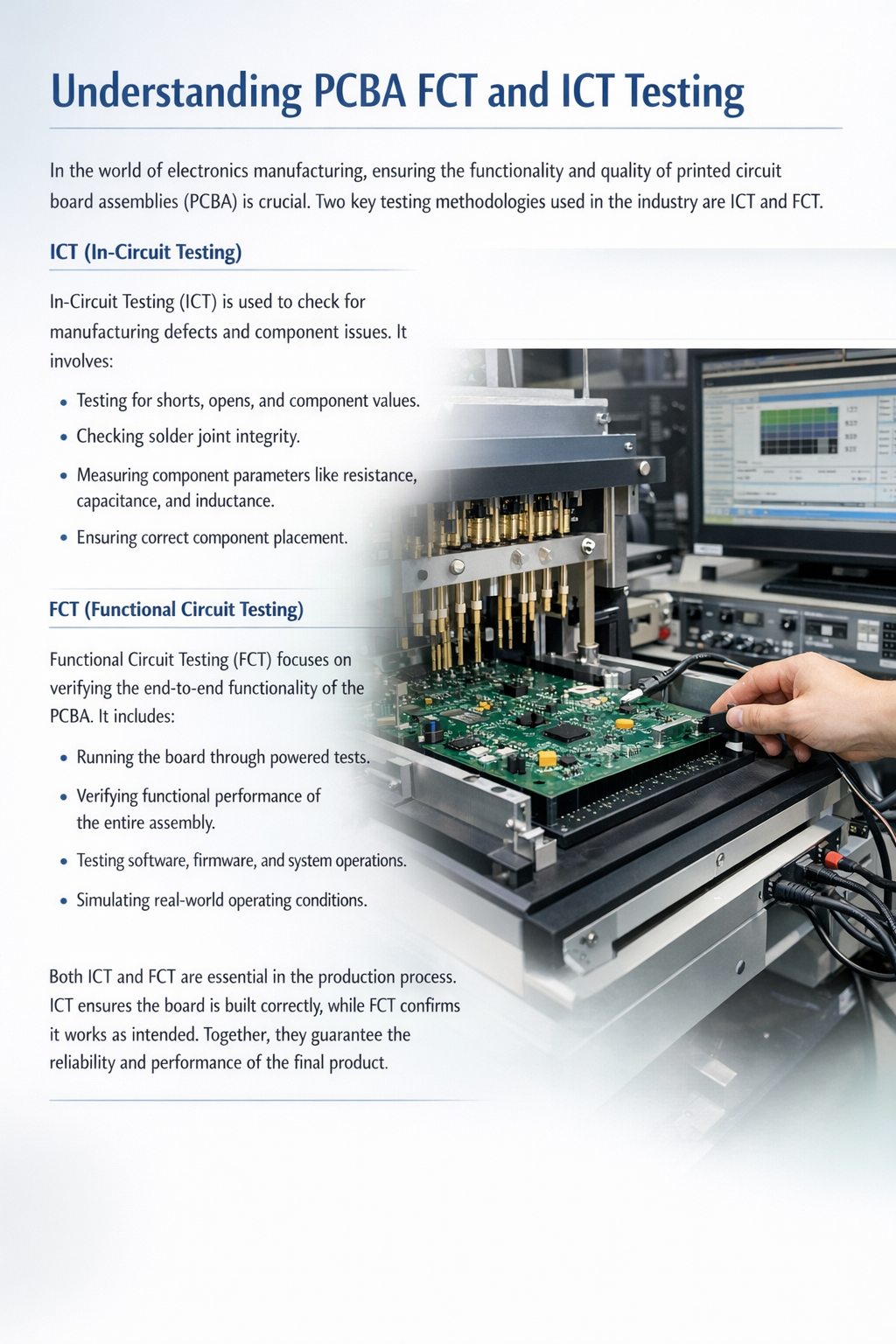

Understanding PCBA FCT and ICT Testing
In the electronics manufacturing industry, ensuring the reliability and functionality of Printed Circuit Board Assemblies (PCBA) is essential. Two of the most critical testing methods used during the production process are In-Circuit Testing (ICT) and Functional Circuit Testing (FCT). Each plays a unique role in quality assurance, and together they help guarantee a high-performance final product.
What is ICT (In-Circuit Testing)?
In-Circuit Testing (ICT) is a manufacturing test method used to identify defects at the component level on a PCB. It is typically performed after the assembly process and before functional testing.
ICT focuses on verifying the integrity of individual components and connections on the board. Using a bed-of-nails fixture or flying probe system, ICT can quickly detect a wide range of issues, including:
- Short circuits and open circuits
- Incorrect component placement or orientation
- Faulty or missing components
- Incorrect component values (resistance, capacitance, etc.)
- Poor solder joints
Because ICT is highly automated and precise, it is extremely effective for catching manufacturing defects early in the production line, reducing downstream failures and rework costs.
What is FCT (Functional Circuit Testing)?
Functional Circuit Testing (FCT) evaluates whether the PCBA performs according to its intended design and functionality. Unlike ICT, which focuses on individual components, FCT tests the board as a complete system.
During FCT, the PCBA is powered on and subjected to real-world operating conditions. The test setup often includes custom fixtures, test software, and simulation environments. Key aspects of FCT include:
- Verifying overall circuit functionality
- Testing input/output signals and communication interfaces
- Running firmware or software validation
- Simulating actual operating conditions
- Ensuring system-level performance and reliability
FCT ensures that the product not only is built correctly, but also works as expected in real applications.
ICT vs FCT: Key Differences
| Aspect | ICT | FCT |
|---|---|---|
| Test Level | Component level | System level |
| Purpose | Detect manufacturing defects | Verify functionality |
| Timing | Early in production | Later stage |
| Equipment | Bed-of-nails / probes | Functional test fixtures |
| Coverage | Electrical integrity | Real-world performance |
Why Both ICT and FCT Are Important
ICT and FCT are complementary rather than interchangeable. ICT helps identify defects early, minimizing waste and improving production efficiency. FCT, on the other hand, ensures that the final product meets performance requirements and customer expectations.
By combining both testing methods, manufacturers can achieve:
- Higher product reliability
- Reduced failure rates
- Lower repair and warranty costs
- Improved customer satisfaction
Conclusion
In today’s competitive electronics market, quality control is more important than ever. ICT and FCT are essential tools in the PCBA testing process, each addressing different aspects of product quality. Implementing both methods ensures that every board leaving the production line is not only defect-free but also fully functional and ready for real-world use.