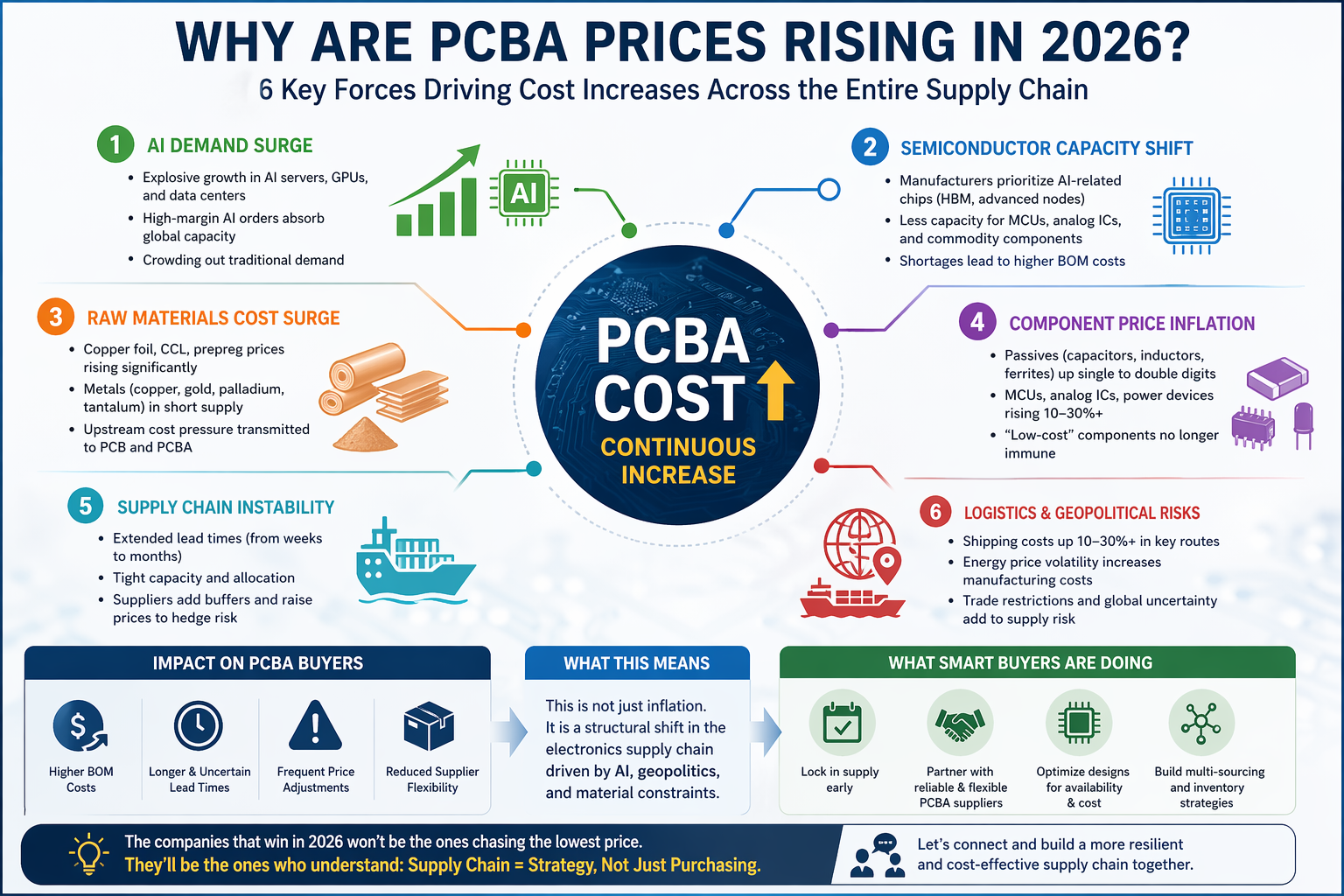

PCBA Market Analysis 2026: Why Are Material Prices Rising Across the Board?
PCBA Market Analysis 2026: Why Are Material Prices Rising Across the Board?
1. Executive Summary
In early 2026, the global PCB & PCBA industry is experiencing a new wave of price increases across almost all material categories—from semiconductors and passives to laminates and logistics.
This is not a single-factor issue, but the result of multiple structural forces converging at the same time:
- AI-driven demand surge
- Raw material inflation
- Supply chain disruptions
- Geopolitical risks
- Capacity reallocation in the semiconductor industry
2. Key Drivers Behind PCBA Price Increases
🔹 1. Explosive Demand from AI & Data Centers
The biggest structural driver is AI infrastructure demand.
- AI servers require massive volumes of memory, GPUs, PCBs, and high-end components
- Semiconductor demand has surged sharply, with industry revenues growing rapidly
- Memory shortages are pushing prices up significantly across the board
👉 Result:
Traditional consumer and industrial supply is being squeezed by high-margin AI demand.
🔹 2. Semiconductor Shortages & Capacity Shift
The semiconductor ecosystem is undergoing a strategic shift:
- Manufacturers are prioritizing HBM / AI-related chips over standard DRAM/NAND
- Memory prices have surged and may continue rising through 2026
- Some forecasts expect price spikes up to 50% for key components
👉 Result:
Component shortages directly increase PCBA BOM costs.
🔹 3. Raw Material Inflation (Core PCB Materials)
PCB upstream materials have seen sharp increases:
- Copper foil: +35%
- Prepreg: +40%
- CCL: up to +45%
At the same time:
- Metals like copper, tantalum, palladium, gold are rising due to demand and supply constraints
👉 Result:
Bare PCB cost is rising significantly, especially for HDI and high-layer boards.
🔹 4. Passive Components & Electronic Parts Inflation
- Capacitors, inductors, ferrites are increasing single-digit to double-digit %
- MCUs, analog ICs, and high-reliability components are seeing 10–30% price hikes
👉 Result:
Even “low-cost” components now contribute to overall BOM inflation.
🔹 5. Supply Chain Disruptions & Lead Time Extension
- PCB lead times extended from 6 weeks to 6 months
- Global supply chains remain unstable due to geopolitical and logistics issues
👉 Result:
Inventory risk increases → suppliers raise prices to hedge uncertainty.
🔹 6. Geopolitical & Trade Factors
- Export controls on key materials (e.g., rare metals, gallium)
- Conflicts impacting energy, shipping routes, and raw material supply
👉 Result:
Higher transportation + energy + compliance costs.
🔹 7. Logistics & Energy Cost Inflation
- Shipping costs increased by 10–30%+ in some routes
- Oil and energy volatility impacts manufacturing and transportation
👉 Result:
Hidden costs are now a major part of PCBA pricing.
3. Market Impact on PCB/PCBA Industry
📈 Short-Term (2026)
- Continuous price pressure across all materials
- Frequent supplier price adjustments
- Longer lead times and tighter allocation
📉 Mid-Term (Late 2026–2027)
- Some stabilization possible (especially memory)
- But structural cost base likely remains higher than pre-2024 levels
4. Strategic Implications for Buyers
For OEMs / EMS / PCBA buyers:
- ✅ Secure long-term supply agreements
- ✅ Diversify supplier base
- ✅ Increase forecast visibility & inventory planning
- ✅ Consider design optimization / alternative components
5. Conclusion
The current PCBA price increase is not a temporary fluctuation—it reflects a structural shift in the electronics industry driven by AI, geopolitics, and material constraints.
Companies that adapt their sourcing and supply chain strategies early will be in a much stronger position to manage cost and risk in 2026 and beyond.